DEHUMANISATION 2 REHUMANISATION
DEHUMANISATION 2 REHUMANISATION
·
DEHUMANISATION 2 REHUMANISATION
·
DEHUMANISATION 2 REHUMANISATION
·
DEHUMANISATION 2 REHUMANISATION · DEHUMANISATION 2 REHUMANISATION · DEHUMANISATION 2 REHUMANISATION ·
WHAT SETS US APART
1. REHUMANISATION
Rehumanise names an active refusal of dehumanisation. It means restoring dignity, voice, and agency where systems of power—through race, gender, class, or colonial inheritance—have reduced people to categories, problems, or functions. To rehumanise is not symbolic or sentimental; it is a deliberate act of recognition that insists on full personhood and lived complexity.
Rehumanisation describes the collective process that grows from this act. As a movement, it confronts the structures that normalise inequality and disposability, while repairing the psychological and cultural damage those structures cause. In struggles around race and gender, rehumanisation reframes survival, care, and self-definition as forms of resistance, restoring humanity to those denied it and exposing the moral cost of oppression itself.
From this ground, rehumanisation becomes a pathway to cultural capital. By reclaiming stories, skills, memory, and meaning that have been suppressed or distorted, communities convert restored dignity into lasting capacity. Cultural capital, in this sense, is not elitism but inheritance: the power to define oneself, educate future generations, and participate in society as fully human.
WHAT SETS US APART
2. WORLD CITIZENSHIP
World Citizenship describes an ethical orientation in which individuals recognise their shared humanity beyond borders of nation, race, gender, religion, or class, and accept responsibility for the wellbeing of the wider human family. It affirms local culture and identity while rejecting hierarchies of worth, grounding belonging not in passports or power, but in mutual dignity, care, and accountability to the planet and to one another.
WHAT SETS US APART
3. CULTURAL CAPITAL
Cultural Capital refers to the accumulated knowledge, values, skills, language, memory, and creative expression that enable individuals and communities to navigate society with confidence, legitimacy, and agency. It is formed through family, education, history, and lived experience, and determines whose voices are recognised, whose knowledge is valued, and who can convert culture into social, economic, and civic power.
4. CRITICAL THINKING
Critical Thinking is the disciplined ability to analyse information, question assumptions, evaluate evidence, and recognise bias—both in external sources and in oneself. It moves beyond passive acceptance toward active understanding, enabling people to make reasoned judgments, resist manipulation, and respond thoughtfully rather than reflexively to complex situations
THE INTERFACE
The INTERFACE is a relational model of human encounter—an explicit map of what is actually present when two people meet, communicate, or work together, whether they acknowledge it or not.
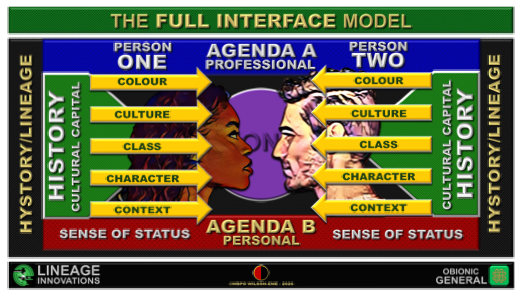
The INTERFACE is a relational model of human encounter—an explicit map of what is actually present when two people meet, communicate, or work together, whether they acknowledge it or not.
At the centre are Person One and Person Two, facing each other as equals in form but not necessarily in power or positioning.
Between them sits Agenda A (Professional) above and Agenda B (Personal) below, signalling that every interaction runs on two simultaneous tracks: the stated, task-focused purpose and the unstated, human undercurrent of emotion, identity, and lived experience.
Neither Agenda is neutral, and tension arises when one is privileged while the other is ignored.
On each side, History / Lineage feeds into CULTURAL CAPITAL, represented by stacked vectors—COLOUR, CULTURE, CLASS, CHARACTER, CONTEXT—all moving towards the interaction.
This shows that no one arrives as a blank slate; each person brings inherited memory, social positioning, and accumulated meaning that shape perception, behaviour, and expectation.
At the base sits Sense of Status, grounding the model in the reality that interactions are always inflected by perceived rank, value, or legitimacy, whether personal or institutional.